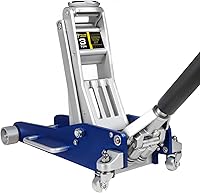
Who Makes Daytona Floor Jacks?
Daytona floor jacks are a house brand owned by Harbor Freight Tools, so no separate outside jack company's name goes on the label. Harbor Freight sources them from contract factories and backs them with its own warranty and parts support.
On this page (6 sections)
Daytona floor jacks are a house brand owned by Harbor Freight Tools. There is no independent Daytona jack company; the retailer owns the name, sets the specifications and sells the jacks through its own stores and website.
That single fact answers most of what buyers want to know. The name on the handle belongs to the store, not to a factory.
Understanding how that works helps you judge the warranty, the parts path and whether the jack is right for your garage.
Who makes Daytona floor jacks?
Harbor Freight owns the Daytona brand and sources the jacks from contract manufacturers. The factories build to the retailer's spec, and the finished jack carries the Daytona label rather than the factory's name.
This is common in the tool trade. A store decides on a capacity, a lift range, a finish and a price point, then finds a factory able to hit those numbers.
The store's name goes on the product, and the store stands behind it.
What you get as a buyer is a jack designed around one retailer's requirements. The lift range, saddle size, frame steel and paint color all come from that brief.
None of it tells you which plant made a given unit, because that detail isn't part of the brand's public story.
The practical takeaway is simple. When you need help with a Daytona jack, the store is the first call.
That is also true for many other jacks sold under store names, including the aluminum and steel models we cover in our Yellow Jacket floor jack notes.
Why the factory name stays hidden
A contract factory usually builds for several customers at once, and those customers compete on the same shelf. The factory's name would hand shoppers a shortcut to compare products that are meant to look different.
So the retailer keeps the plant quiet and asks buyers to judge the jack by its own label instead.
For you, the hidden factory means the spec sheet is your best evidence. If the jack lists its capacity, lift range and overload protection, those numbers are the same whether one plant or another built it.
A name you can't verify adds nothing you can use.
Is Daytona the same as Pittsburgh?
No. Daytona and Pittsburgh are separate Harbor Freight house brands with different jack lines and different price positions.
They share a retailer, not a product.
Shoppers sometimes assume the two names come from one factory and differ only in the sticker. The safer view is that each line has its own design choices and its own place on the shelf.
Daytona tends to sit at the higher end of the store's jack range.
That matters when you compare reviews or look up parts. A fix or a complaint about one line doesn't automatically carry over to the other.
Check the model number on your own jack before you order seals or ask for service.
If you are weighing a house brand against a named jack brand, focus on the numbers that affect your car. Capacity, minimum height and maximum lift do more for you than the badge.
Our guide to how much a floor jack weighs is a useful next check, because a heavier steel jack is harder to move around the garage.
What does a house brand mean for warranty and parts?
Warranty and parts support run through the retailer, not a distant factory. Keep your receipt and the model number from the jack's label, because both make a claim or a parts order much easier.
House-brand jacks often use common hydraulic parts: seals, O-rings, release valves and pump assemblies. Some of these are shared across many jacks, which is why a seal kit can sometimes fit more than one model.
Still, confirm the fit against your model number before you buy.
The weak point in any house-brand purchase is the paper trail. If you lose the receipt or the model label wears off, matching a part gets harder.
Photograph the label when the jack is new and store the picture with your receipt.
Skip the house brand if you want a factory service center with the maker's name on the door. That kind of support is rare for any jack at this price, though.
For most home mechanics, the store counter is the realistic service path.
How do you judge a Daytona jack on its own merits?
Judge the jack by its rated capacity, lift range and safety features, not by the brand story. A house brand can build a good jack, and the specs tell you whether it suits your car.
Start with the load rating against the weight of the end of the car you plan to lift. Then check the minimum height for a low car and the maximum lift for a truck or SUV.
A jack that can't reach the lift point is no help, whatever its name.
Look for an overload protection valve, a wide saddle and a stable base. Those features reduce the chance of a bad lift.
They matter more than which factory pressed the steel.
Weight is the other everyday factor. A steel service jack is heavy to carry and roll, while an aluminum and steel model is easier to move.
Our guide to how much a floor jack weighs breaks down what to expect from each build.
The Yellow Jacket model shows how a named brand states its case. It lists a 1.5 ton capacity, a lift range of 3.5 to 14 inches and a dual-piston pump.
Those are the kinds of numbers to compare against any Daytona model you are considering. Torin is named as the manufacturer on this jack, which gives you a clear brand to contact for its 1-year warranty.
One detail worth copying from that jack is how it states its limits. It notes that SUVs or larger vehicles may not be liftable if their weight exceeds 1.5 tons.
A house-brand jack should be read the same way. The rated capacity is a ceiling, not a suggestion, so match it to the corner of the car you are raising and leave margin.
What should you check before buying a house-brand jack?
Check the return window, the warranty terms and the parts path before you pay. A house brand's after-sales support is only as good as the store behind it.
Ask how long the warranty runs and what it covers. Confirm that the store stocks or can order seals and valves for the model.
A jack that leaks after a year is a paperweight if no part is available.
Then handle the jack in the store if you can. Roll it, lift the handle and feel how the release works.
A smooth release makes lowering the jack slowly much easier, and that is where many cheap jacks feel rough.
Check the saddle size against your lift points and the frame against your storage space. Our guide to how to store a floor jack covers keeping it upright and dry, which protects the seals between jobs.
The DNA Motoring kit is a useful comparison point for a house-brand shopper. It pairs a 2 ton low-profile jack with two ratchet stands that adjust from 11 to 17 inches.
The jack lifts from 5.1 to 13 inches, and the set includes an overload valve. If you don't already own stands, a kit like this covers both jobs at once.
DNA Motoring is the named manufacturer, so warranty questions go to the seller named in its paperwork.
Do you need to know the factory to own the jack?
No. You need the model number, the receipt and a safe lifting routine, and the factory name adds little to daily ownership.
House brands are normal in the tool world. What separates a good purchase from a bad one is whether the jack meets its rated load, releases smoothly and gets stored properly.
A brand name on the handle doesn't change any of that.
Use the jack only to lift, and put stands under the car before you go underneath. Keep the fluid level in check and store the jack with the piston down.
If it stops lifting, our guide to why a floor jack won't lift walks through the usual causes.
The MaxxHaul chock pair is a small addition that makes any lift safer. Each chock measures 8 x 4 x 6 inches and is molded from solid rubber with a built-in handle.
They grip pavement, gravel and smooth garage floors, so the car stays put while you work. The molded handle means you can set and pull them without hunting for a metal ring, and the oil-resistant rubber holds up when the garage floor is less than clean.
So who makes Daytona floor jacks? Harbor Freight owns the brand, contract factories build the jacks, and the store handles warranty and parts.
Judge the jack by its capacity and lift range, keep the receipt and model number safe, and support the car on stands every time. That routine matters more than the name on the label.
Frequently asked questions
Who actually manufactures Daytona floor jacks?
Daytona is a private-label brand owned by Harbor Freight Tools. The jacks are built by contract factories, mostly in Asia, and sold under the Daytona name.
Harbor Freight owns the brand, sets the specs and handles warranty claims rather than a stand-alone jack manufacturer.
Can you get replacement parts for a Daytona floor jack?
Parts support runs through Harbor Freight, so start with the store where you bought the jack. Keep your receipt and the model number from the label.
Many seals and release valves are common hydraulic parts, but confirm the fit before swapping anything.
Is a house-brand floor jack a safe choice?
A house brand can be a safe choice if the jack meets the rated capacity and you use stands under the car. The brand name matters less than the load rating, the lift range and a working overload valve.
Always support the vehicle on stands before going underneath.