Where Is the Release Valve on a Floor Jack?
The release valve on a floor jack sits at the base of the handle, on the pump housing near where the handle socket meets the jack body. It's the small screw or knob you turn to let hydraulic fluid back into the reservoir so the saddle lowers.
On this page (7 sections)
- Where exactly is the release valve located?
- How do you tell the release valve from the fill plug?
- Which way do you turn it to lower the jack?
- What if the jack won't lower when you turn the valve?
- How do you keep the valve working properly?
- Does the valve type change how you use the jack?
- Quick answer recap
The release valve on a floor jack sits at the base of the handle, on the pump housing where the handle socket meets the jack body. It's the small screw or knob you turn to let hydraulic fluid back into the reservoir so the saddle lowers.
Finding it takes a few seconds once you know what you're looking at. The tricky part is telling it apart from the fill plug and the lifting mechanism, then turning it the right way without dropping the load.
Where exactly is the release valve located?
Look at the base of the handle on the pump housing, just above where the handle slots into the jack. That's where the release valve sits on almost every floor jack, because the handle itself is often the tool that turns it.
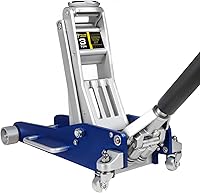
On the AV Steel 3 Ton Low Profile Dual Piston Floor Jack, the pump housing carries the dual pistons and the valve sits at the handle end. Many jacks have a small screw head or a slotted knob there, sometimes marked with an arrow or the words "open" and "close".
Some models put the release valve on a separate knob beside the handle rather than at its base. On those jacks you twist the handle to pump and turn the knob to lower, so the two jobs stay separate.
A few low-profile designs tuck the valve lower on the housing so the handle can swing without catching it.
The valve is not the saddle, the lift arm or the wheels. It's the one small part on the pump body that turns without lifting anything.
How the low-profile layout changes what you see
On a low-profile jack the pump housing sits closer to the ground, so the release valve is lower and easier to reach without tilting the jack. That matters when the car has only a few inches of clearance and you're working by feel rather than by sight.
The AV Steel jack has a minimum lift height of 3-1/8 inches, so the whole pump body stays tucked under the bumper. Its dimensions are 29-1/8 by 13-3/4 by 5-7/8 inches, which keeps the handle base close to the front edge where you can find the valve by hand.
Get down level with the jack and follow the handle down to the housing. The valve is the fitting that turns at the handle end, not the lug bolts or the rear wheel brackets.
How do you tell the release valve from the fill plug?
The release valve is the fitting you turn to lower the saddle; the fill plug is the one you remove to add oil. They sit close together on the pump housing, which is why they get confused.
The release valve usually has a screw head or a knob you can turn a small amount in each direction. The fill plug sits higher on the reservoir and often has a rubber or plastic cap, or a larger hex fitting you remove completely.
On many jacks the release valve is the same screw the handle engages, so turning the handle clockwise pumps and turning it counterclockwise releases. The fill plug stays put during normal use and only comes out when the fluid is low.
If you're not sure which is which, check the jack's instructions before your first lift. Opening the fill plug while the jack is under load can spray hydraulic fluid.
Which way do you turn it to lower the jack?
Turn the release valve counterclockwise to open it and lower the saddle, and clockwise to close it before lifting. The direction is usually stamped near the valve, so look for an arrow or the words "open" and "close".
Open the valve only a small amount. Turning it fully open lets the fluid rush back and the saddle drops fast, which is hard on the jack and risky for whatever is on it.
A quarter to a half turn is usually enough to start a slow descent.
Close the valve firmly before pumping. A valve left partly open makes the handle feel spongy and the jack won't hold its height.
Tighten it by hand only, since over-tightening can damage the valve seat.
On a dual piston jack the handle does two jobs at once, and the pump feels different in each direction. Clockwise it drives both pistons and lifts the saddle quickly with fewer strokes.
Counterclockwise it opens the release path and the fluid returns to the reservoir. If the handle spins freely with no resistance in either direction, the valve is already open and needs a clockwise turn before the next lift.
Our guide to how to lower a floor jack slowly and smoothly walks through the full descent, including how to feather the valve so the load settles without a jolt.
What if the jack won't lower when you turn the valve?
Open the valve a little more and check the fluid level, because a stuck saddle usually means the valve is blocked or the jack is low on hydraulic oil. Support the vehicle on jack stands before you investigate.
A jack that won't come down often has a valve that's only partly open, or a saddle still carrying weight. Lower the load onto stands, then turn the valve out a little more and listen for the fluid moving.
If the saddle still won't move, the jack may be low on fluid or air-locked. Check the level against the fill plug, and top up with hydraulic jack oil if it's low.
A jack that won't lift at all points to a different problem, covered in our guide to why won't my floor jack lift.
Never crawl under a vehicle held only by a jack while you troubleshoot. Put stands under the frame first and keep the jack as a backup.
How do you keep the valve working properly?
Keep the valve clean and the fluid at the right level, since dirt and low oil are the two things that make a release valve stick. Wipe the pump housing after each use so grit doesn't work into the valve threads.
Store the jack with the valve closed and the handle removed or lowered. Our guide to how to store a floor jack covers keeping it upright and out of damp air, which protects the valve and the seals.
Check the fluid level a couple of times a year. A jack that's low on oil lowers slowly or not at all, and air in the system makes the handle feel spongy.
Top up with a proper jack oil rather than motor oil, which can swell or shrink the seals. The right oil is thin enough to move through the valve passages and thick enough to hold pressure under load, which is why a 10W grade jack oil is the usual choice.
If the valve weeps fluid around its threads, the seal may be worn. A stop-leak additive can slow a small seep, but a valve that won't hold pressure needs a rebuild kit or a new jack.
Does the valve type change how you use the jack?
Yes, the two main types turn differently, and knowing which you have keeps lowering predictable. Most floor jacks use the handle as the release tool, while some use a separate knob.
On a handle-release jack, you pump by turning the handle clockwise and lower by turning it counterclockwise. The handle stays in the socket the whole time, so there's nothing extra to grab when you want the saddle to come down.
On a knob-release jack, the handle only pumps. A separate knob or T-bar beside it opens the valve, which lets you keep both hands on the handle while the load descends.
That layout suits low-clearance work where the handle can't swing far.
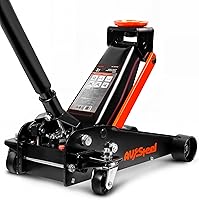
The BIG RED AT815016LR uses a dual piston quick lift pump with a 3.5 to 14 inch lift range, and its low profile makes the handle base easy to reach. Its handle also has a foam bumper and a machined, non-slip knurled grip, which helps when your hands are slick and you're turning the valve by feel.
Either way, the valve is the same part in the same place: at the base of the handle on the pump housing. Once you've found it, the rest is just a small turn in the right direction.
Quick answer recap
The release valve sits at the base of the handle on the pump housing, and turning it counterclockwise lowers the saddle while turning it clockwise closes it for lifting. Find it once, mark the direction if it helps, and open it only a little so the load comes down slowly.
If the saddle won't move or the valve feels stuck, stop and put the vehicle on stands before you investigate. A clean valve and the right fluid level help the jack lower smoothly.
Our guide to how much does a floor jack weigh helps if you're also thinking about storage and transport.
Frequently asked questions
Where is the release valve on a floor jack?
It sits on the pump housing at the base of the handle, close to the handle socket. On most jacks you turn the handle itself to open it, while some models use a separate knob or T-bar next to the handle.
How do I know which way to turn the release valve?
Turn it counterclockwise to open and lower the jack, and clockwise to close it before lifting. The direction is usually stamped on the pump housing or shown in the jack's instructions, so check before your first lift.
Does a floor jack have more than one valve?
Some jacks have a second valve or screw used for filling and bleeding the hydraulic system. The release valve is the one you turn to lower the saddle, so keep the fill screw closed during normal lifting and lowering.
Can I lower a jack with the release valve open too far?
No, opening it fully drops the saddle too fast. Open the valve only a small amount and let the jack come down slowly, which keeps the load stable while it descends.