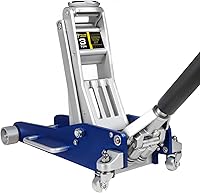
What Size Floor Jack for a Ram 1500?
A 3 ton floor jack is the right size for a Ram 1500 in most cases. It covers the truck's curb weight with margin for one end lifted at a time. Step up to 4 tons for heavy 4x4 trims, lifted trucks or if you plan to lift the whole truck, and check saddle height on lifted rigs.
On this page (8 sections)
- How much does a Ram 1500 weigh at the axle?
- Which trims and drivetrains change the answer?
- Why saddle height matters more than tonnage on a 1500
- How to size the jack to your working routine
- Do you need a 4 ton jack for a lifted Ram 1500?
- What else should you check before buying?
- How should you lower a Ram 1500 safely?
- What size floor jack should you buy for a Ram 1500?
A 3 ton floor jack is the right size for a Ram 1500 in almost every case. It rates 6,000 lb, which covers a typical 1500's curb weight with margin, because you lift one end at a time.
Choose 4 tons only for the heaviest 4x4 trims, lifted trucks or frequent use.
The answer depends on three things more than the badge on the side: what your truck weighs, how high its jack points sit, and whether the jack's saddle can reach and clear the frame. The sections below break each one down.
If you are still deciding whether a truck jack is the same as a car jack, our what size floor jack for a pickup truck guide covers the full range of trucks.
How much does a Ram 1500 weigh at the axle?
A typical Ram 1500 weighs about 5,000 to 5,800 lb depending on cab, bed and drivetrain. A 3 ton jack handles that load comfortably because it never holds the whole truck at once.
That split matters more than total weight. When you lift the front, the jack carries the front axle share; when you lift the rear, it carries the rear share.
Neither is the full curb weight.
Why a 3 ton rating leaves margin
A 3 ton jack is rated for 6,000 lb. Even a heavy Crew Cab 4x4 1500 leaves several hundred pounds of headroom against the full curb weight, and far more against one axle's share.
Margin matters for two reasons. Real loads shift when the truck is loaded or towing, and a jack near its limit wears faster and feels less stable.
A 3 ton jack at half its rating is the comfortable zone for a 1500.
Lifted trucks and heavier payloads change the math. If your truck carries tools, a camper or a plow, count that weight before trusting a 3 ton rating.
When to move up to 4 tons
Step to a 4 ton jack when your truck is a heavy 4x4 trim with added accessories, when it is lifted, or when you lift it often and want extra reserve. The 4 ton model here rates 8,000 lb.
That extra capacity comes with weight. The 4 ton AV Steel unit weighs 87.3 lb, against 57.8 lb for the aluminum 3 ton Yellow Jacket.
Moving it around matters if you store it up a shelf or drag it across a driveway.
Rule: buy 3 tons for a stock or lightly loaded 1500, and 4 tons for a heavy 4x4 or lifted truck you service often.
Which trims and drivetrains change the answer?
Drivetrain and cab size change the answer more than the badge suggests. A 2WD Regular Cab and a 4x4 Crew Cab both wear the Ram 1500 name but differ in weight and jack point height.
A 4x4 sits higher than a 2WD, so the jack needs more lift and a taller minimum height still has to slide under the frame. That is where jack selection starts to matter more than raw tonnage.
2WD and light 4x4 trims
A 2WD 1500 or a light 4x4 with a smaller cab usually sits within reach of a standard 3 ton jack. The Yellow Jacket's 3.75 in minimum height and 18.9 in maximum suit those trucks well.
The dual-piston pump means fewer strokes to reach the frame, which helps when you lift the front and rear in turn. The 6,600 lb rating covers a stock 1500 with room left over.
Pick this for a 2WD or light 4x4 1500 you service at home. Its low saddle height also helps on trucks with low jack points.
Heavy 4x4 trims and lifted trucks
A heavy 4x4 or lifted 1500 needs a jack with more lift and more reserve. The AV Steel 4 ton model reaches 19.75 in and rates 8,000 lb, so it clears lifted frames more easily.
Its dual-piston pump speeds up the lift, and the 360-degree saddle helps you line up with a lifted frame's jack point. The trade-off is the 87.3 lb weight, which makes it a garage fixture rather than a jack you carry in the truck.
Pick this for a lifted or heavy 4x4 1500. The extra reach and capacity are worth the weight if the truck stays home for service.
Why saddle height matters more than tonnage on a 1500
Saddle height decides whether the jack fits under the truck and reaches the frame. On a 1500, especially a lifted one, a jack that cannot reach the jack point is useless no matter how much it can lift.
Two numbers matter. Minimum height tells you whether the jack slides under the frame with the truck at rest.
Maximum height tells you how far it can lift before you place stands.
Minimum height for a stock 1500
A stock 1500 usually has enough clearance for a jack with a minimum height around 3.75 to 5.5 in. The Yellow Jacket starts at 3.75 in; the AV Steel 3 ton starts at 5.5 in.
If your truck has low ground clearance or you want to slide the jack in without lifting the frame first, the lower start helps. The aluminum Yellow Jacket's 3.75 in gives it the edge there.
Maximum lift for lifted trucks
Lifted 1500s often need more than 19 in of saddle travel to reach a comfortable working height for stands. The 4 ton AV Steel reaches 19.75 in, while the 3 ton models top out at 18.5 to 18.9 in.
If your lift kit raises the frame by 3 to 6 in, count the extra height before choosing. A 3 ton jack may still reach the frame, but it leaves less room to raise the truck enough to slide stands underneath.
Reading the travel on the three jacks
The three jacks here sit in a clear order. The Yellow Jacket 3 ton runs from 3.75 to 18.9 in.
The AV Steel 3 ton single-piston runs from 5.5 to 18.5 in. The AV Steel 4 ton dual-piston runs from 4-1/4 to 19-3/4 in.
The 4 ton model has the tallest top end, but its 8.05 in minimum height means it needs more room underneath before the saddle even touches the frame. That is the number to check on a lifted 1500, because a high start can stop the jack from fitting under the jack point in the first place.
Measure the gap between the ground and the frame at each jack point, then compare that gap to the jack's start height. If the gap is only a little more than the start height, the saddle will scrape or not fit.
Leave yourself a few inches of room so the saddle meets the frame squarely.
Rule: match the jack's maximum lift to your truck's frame height plus the height of your tallest jack stands.
How to size the jack to your working routine
Your routine decides whether a 3 ton jack is enough or you want the 4 ton reserve. A driveway oil change and a full brake job are different jobs with different demands.
Think about how often you lift, how high you need the truck, and how much the jack's own weight matters when you move it in and out of storage.
Occasional driveway work
For tire rotations, brake checks and the odd oil change, a 3 ton jack covers a 1500. The AV Steel 3 ton single-piston model is a steel workhorse for that kind of use.
Its 6,000 lb rating and 5.5 to 18.5 in lift range suit a stock 1500 for tire and brake work. The single-piston pump takes more strokes than a dual-piston jack, so lifting takes a little longer.
The steel build weighs 63.8 lb and gives a stable feel on the driveway. Pick this for occasional service on a standard 1500 where the extra lift speed is not worth the cost.
Frequent and heavy work
If you lift the truck often or work on a heavy 4x4, the 4 ton dual-piston model earns its weight. Fewer strokes and more reserve make repeated lifts less tiring.
The dual-piston pump on the 4 ton AV Steel moves the saddle with fewer handle strokes than a single-piston design. That matters when you lift the same truck several times in one afternoon.
Its 87.3 lb weight and full-size steel frame suit a garage where the jack stays put. Pick this when the truck is lifted often or the truck itself is heavy.
If you move the jack around a lot, weight becomes part of the decision. Our guide to how much does a floor jack weigh compares aluminum and steel options by pounds.
Do you need a 4 ton jack for a lifted Ram 1500?
Not always, but a 4 ton jack is the safer default for a lifted 1500. The lift kit raises the frame, so the jack needs more saddle travel, and the extra capacity gives margin for the heavier wheels and tires a lifted truck usually carries.
The 4 ton AV Steel reaches 19.75 in and rates 8,000 lb. That combination covers most lift kits without forcing you to stack blocks under the saddle.
Blocks under the saddle are a real hazard. A jack that reaches the frame on its own is safer than a smaller jack boosted with wood or cribbing.
Choose the jack whose travel matches the truck, not the other way around.
The 4 ton model also weighs more, so plan where it lives. A jack stored on a shelf or a wall mount needs to be light enough to lift safely.
Our guide to how to store a floor jack covers garage storage that keeps a heavy jack off the floor.
Rule: if your 1500 is lifted, buy a jack whose maximum lift clears the frame without blocks, even if a 3 ton rating would technically carry the weight.
What else should you check before buying?
Check the jack's weight, its saddle design and its safety features before you commit. These details decide how pleasant the jack is to use and how safe it feels under a 1500.
Weight matters for storage and moving. A 57.8 lb aluminum jack is easy to carry; an 87.3 lb steel jack is not.
Pick the one that fits your storage and your back.
Jack weight and storage
The Yellow Jacket 3 ton aluminum jack weighs 57.8 lb, light enough to lift onto a shelf or carry to the truck. The AV Steel 4 ton steel jack weighs 87.3 lb and wants a floor spot or a low shelf.
If you store the jack in a garage with limited floor space, plan the spot before buying. A heavy jack on a high shelf is a hazard, and a light jack that rattles around the bed is not much better.
Saddle, pump and safety features
All three jacks here use an overload safety valve that stops the lift if the load exceeds the rating. That is the basic protection you want under a truck.
The 360-degree saddle on the AV Steel models helps line up with a 1500's jack points, which sit in specific spots along the frame. A large rubber saddle on the Yellow Jacket protects the frame from scratches.
The handle details matter too on a truck this size. The Yellow Jacket has a foam bumper on the handle for comfort and an anti-slip handle design, and the AV Steel jacks ship with a product manual that covers the release valve and lift procedure.
Yellow Jacket says the jack meets the ASME standard, and AV Steel says its models meet ANSI/ASME PASE standards.
The aluminum jack's two swivel rear casters and two front rollers make it easy to slide into position under a 1500 without dragging it across the driveway. The side handle helps when you lift it in and out of storage.
The AV Steel models use two rear rotating wheels for the same job of repositioning the jack.
Rule: buy a jack with an overload valve, a saddle that fits your jack points and a weight you can move safely.
How should you lower a Ram 1500 safely?
Lower the truck slowly and in stages, and never work under it while the jack alone holds the weight. A 1500 is heavy enough that a sudden drop can damage the frame or hurt you.
The release valve controls the descent. Turn it a small amount and let the truck settle onto the stands before turning it further.
Lowering in steps
Lower the truck onto jack stands first, then remove the stands only when the work is done. Turn the release valve slowly, a quarter turn at a time, and let the truck settle between turns.
Keep your hands and tools clear of the frame as it comes down. A 1500 dropping even a couple of inches lands with force.
Our guide to how to lower a floor jack slowly and smoothly walks through the release valve technique in more detail. It is the step where most driveway mishaps happen.
Rule: lower in small steps, onto stands or the ground, and never rush the release valve.
What size floor jack should you buy for a Ram 1500?
Buy a 3 ton floor jack for a stock or lightly loaded 1500, and a 4 ton jack for a heavy 4x4 or lifted truck. The 3 ton Yellow Jacket covers most 1500s with its 6,600 lb rating and 3.75 in low profile.
The 4 ton AV Steel adds reach and reserve for lifted rigs.
The 3 ton AV Steel single-piston model is the middle choice. It gives up lifting speed to the dual-piston jacks, but its 6,000 lb rating and 18.5 in top height still cover a standard 1500 for tire and brake work.
Match the jack to the truck's weight and frame height first, then to how often you lift and how much the jack's own weight matters. A 3 ton jack at half its rating feels stable and lasts longer than one pushed to its limit.
If you are unsure which trim you have or how high your lift kit sits, measure the frame height at the jack points before buying. That number, more than any badge, tells you whether a 3 ton or 4 ton jack is the right fit for your 1500.
Frequently asked questions
Is a 3 ton floor jack strong enough for a Ram 1500?
Yes, for most Ram 1500 trims. A 3 ton jack rates 6,000 lb, well above the curb weight of a typical 1500 and above the weight on one axle when you lift the front or rear.
Step to 4 tons for heavier 4x4 trims or lifted trucks.
What lift height does a Ram 1500 floor jack need?
Aim for at least 18 inches of maximum saddle height for stock trucks and more for lifted ones. Standard 3 ton jacks reach about 18.5 to 18.9 inches, while the 4 ton model here tops out at 19.75 inches.
Can I lift the whole Ram 1500 with one floor jack?
No. A floor jack lifts one end or one corner at a time.
For a full four-point lift, use a set of jack stands or a proper vehicle lift, and never work under a truck supported only by the jack.