What to Look for in a Floor Jack
Look for four numbers before anything else: capacity above your vehicle's curb weight, a low start height that clears your jacking point, a max lift height that raises your tire, and a saddle wide enough to sit flat. Then match the chassis type and safety features to how often you plan to use it.
On this page (9 sections)
- What capacity floor jack do I need for my car?
- Why does the start height matter so much?
- What max lift height do you actually need?
- Which chassis type suits your garage?
- Which safety features are non-negotiable?
- Should you buy hydraulic jack oil with the jack?
- How much does a floor jack weigh, and where will it live?
- Is a budget floor jack good enough for home use?
- The verdict: match the jack to your lowest car
The first thing to look for in a floor jack is capacity above your vehicle's curb weight, then a start height low enough to slide under your jacking point. After that, check the max lift height, the saddle, the chassis type and the safety features.
Get those six right and the jack will do the job without fighting you.
Most buyers start with capacity and stop there. That is a mistake.
A 3 ton jack that cannot reach your SUV's frame or fit under a lowered car is the wrong jack no matter how strong it is.
This guide walks through each spec in the order that matters. It also names the models we would pick for the jobs readers ask about most.
What capacity floor jack do I need for my car?
Buy a jack rated above your vehicle's curb weight, not exactly at it. A 3 ton (6,000 lb) jack covers most cars, SUVs, vans and light trucks.
A 2 ton jack suits compact cars and light duty.
Capacity is a rating for the whole jack, not the corner you lift. The jack still needs margin because a corner can carry more than a quarter of the vehicle's weight when the load shifts.
Pick one size up from the bare minimum when you are close to a limit.
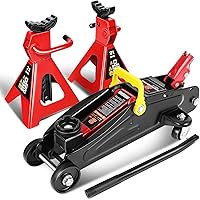
Heavier vehicles and extended-height trucks push you into the 3 ton class for a reason. The BIG RED T83006 is rated at 3 tons (6,000 lb) and reaches a maximum height of 20-7/8 in, which is the sort of reach a lifted truck needs.
Capacity vs curb weight
Check the curb weight on your registration or door sticker. Then add the weight of whatever you carry: tools, cargo, passengers, a full tank.
That total is what the jack has to lift a corner of.
A compact sedan around 2,800 lb can run on a 2 ton jack with room to spare. A midsize SUV near 4,500 lb needs the 3 ton class.
A half-ton pickup is close enough to 6,000 lb that you want the bigger rating or more.
Rule: choose at least 1 ton more capacity than the curb weight divided by two. That covers corner load shifts and gives you a comfortable margin.
Why does the start height matter so much?
The start height decides whether the jack fits under the car at all. If the saddle and body cannot slide beneath your jacking point, the jack is useless even if its capacity is right.
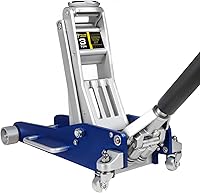
This is where low-profile jacks earn their keep. The Maxority 3 Ton Low Profile is built to slide under low clearance, and Maxority says its long reach helps it reach vehicles with low ground clearance.
That matters for sports cars, lowered cars and anything with bodywork close to the pavement.
The BIG RED T83006 starts at a minimum height of 5-7/8 in. That is fine for most cars and trucks with normal ride height.
It is not going to fit under a lowered car whose subframe sits lower than that.
How to measure your clearance
Park on level ground and look at the jacking point you plan to use. Measure from the ground up to the lowest solid part of the frame or pinch weld near that point.
Then compare that number to the jack's start height. Leave a little room so the saddle and the jack body clear the bumper and any plastic trim.
If your clearance is under about 5-1/2 in, you want a low-profile jack. If it is over 6 in, a standard trolley jack like the T83006 will usually fit.
Rule: the jack's start height should be at least 1/2 in lower than your measured clearance. Anything tighter and you risk scraping the car or the jack.
What max lift height do you actually need?
The max lift height needs to be high enough to get the tire off the ground with room for a jack stand. A jack that tops out before the tire clears the ground leaves you stuck mid-lift.
The T83006 reaches 20-7/8 in. That is a lot of travel for a trolley jack, and it is the reason it suits extended-height trucks and lifted SUVs.
The Maxority tops out at 19.9 in, which is still plenty for most cars and many SUVs.
The gap between start and max is your usable stroke. A jack that starts at 5-7/8 in and tops at 20-7/8 in gives you 15 in of lift.
A low-profile jack with a similar top height gives you more stroke because it starts lower.
Lift height vs stroke
Lift height is the top number. Stroke is how far the saddle travels from its rest position.
For a low car you want a low start and enough top end to raise the tire.
For a tall truck you want a high top end. The start height matters less because there is already space underneath.
That is why the T83006's extra long saddle neck is useful on lifted vehicles: it gets the saddle up to the frame without cranking as long.
Rule: your max lift height should clear your tire plus 2 to 3 in for a jack stand. Add more if you plan to use tall stands or lift a lifted truck.
Which chassis type suits your garage?
The two chassis types you will see are the standard trolley jack and the low profile jack. Both are rolling hydraulic floor jacks.
The difference is how low the body sits and how far the saddle reaches.
A standard trolley jack like the T83006 has two large steel casters and two 360-degree swivel casters. That combination rolls smoothly and turns easily in a garage bay.
A low-profile jack usually has a flatter body to slide under low cars.
There is also the question of what you are replacing. If you are moving up from the tire-change jack in your trunk, a floor jack is a different tool.
Our floor jack vs scissor jack comparison explains when each one makes sense.
Standard trolley jack
Pick a standard trolley jack if your vehicles sit at normal ride height. It gives you more lift travel for the money and rolls well on a smooth floor.
The T83006's casters and swivel wheels make it easy to position. Its single piston quick lift pump raises the saddle with fewer strokes, which saves time on a high lift.
Low profile jack
Pick a low-profile jack if you own a lowered car, a sports car or anything with low bodywork. Its flatter body reaches jacking points a standard jack cannot.
The Maxority's low-profile design and long reach are aimed at exactly that buyer. Maxority also lists a built-in safety valve in the lift saddle to prevent overloading.
Rule: match the chassis to your lowest vehicle, not your tallest. If you own both a truck and a lowered car, buy for the car and add a taller saddle pad for the truck if needed.
Which safety features are non-negotiable?
The safety features you should insist on are an overload bypass valve, a stable saddle, and casters that roll freely on a hard level floor. Everything else is convenience.
Both jacks here include overload protection. The T83006 uses a safety bypass system that prevents over-loading.
The Maxority uses a built-in safety valve in the lift saddle to prevent overloading and to help keep the vehicle from slipping.
A saddle that sits flat under the load matters more than any add-on. A narrow saddle can let the frame rock.
A wide saddle spreads the load and holds the jacking point centered.
Bypass valves and load limits
A bypass valve releases pressure when the jack is pushed past its rating. It is a backstop, not a license to overload.
Stay within the rated capacity and the valve should never need to act.
Saddle stability
Check that the saddle sits flat and that its width covers your jacking point. A rubber-tipped saddle or a pad helps protect paint and grip the load.
Keep any pad centered so it does not slide.
Rule: never work under a vehicle held only by a floor jack. Use jack stands on a hard, level surface every time.
A floor jack lifts; jack stands hold.
Should you buy hydraulic jack oil with the jack?
Buy a bottle of hydraulic jack oil when you buy the jack. A floor jack is a sealed hydraulic tool, and the fluid level is the first thing to check when a jack starts to feel soft or slow to lift.
The Gunk Liquid Wrench M3332 is a 32 oz bottle of hydraulic jack oil with a built-in easy-pour spout. It is made for hydraulic jacks and refillable shock absorbers.
Having it on the shelf means you can top up without a trip to the store.
When a jack needs oil
A jack that sinks slowly under load or needs many pumps to lift is often low on fluid or has air in the system. Check the fluid level and follow the jack's bleed procedure before assuming the jack is worn out.
Keep the oil bottle sealed and stored upright. A little goes a long way, so one bottle lasts a long time for a home garage.
Rule: buy the oil with the jack so the first top-up does not wait. It is a small cost that keeps a hydraulic jack working properly.
How much does a floor jack weigh, and where will it live?
A floor jack is heavier than the scissor jack it replaces, and that weight shapes where you store it. The T83006 weighs 36 lb.
That is light enough for one person to carry by its built-in handle, but heavy enough that you want a set spot for it.
If you are deciding between a floor jack and a lighter jack, weight is a real factor. Our guide on how much does a floor jack weigh breaks down the ranges by size and type.
Storage and handling
A floor jack rolls on its casters, so a flat garage floor makes it easy to move. A dedicated corner keeps the handle and body out of the way.
Our guide on how to store a floor jack covers upright storage and keeping the fluid in good shape.
The T83006 includes a built-in carrying handle for lifting and moving it quickly. That helps if you need to carry it up steps or across a yard to a driveway.
Weight vs portability
Heavier jacks tend to have more steel in the frame and a longer stroke. Lighter jacks are easier to carry but may not reach as high.
Match the weight to how often you move it and whether you store it in one spot.
Rule: if you will carry the jack up stairs or across a yard, weigh it before you buy. If it lives in one garage bay, weight matters less than lift height and reach.
Is a budget floor jack good enough for home use?
A budget floor jack is good enough for occasional home use if it meets your capacity and lift height needs. The BIG RED T83006 is the value pick here, and it covers most cars, SUVs and light trucks at a 3 ton rating.
The T83006 has the numbers that matter: 3 tons of capacity, a 5-7/8 in start height and a 20-7/8 in top height. Its casters roll smoothly and its single piston pump raises the saddle quickly.
It also carries a limited 1 year manufacturer warranty.
For a lower car or a buyer who wants a flatter body, the Maxority low-profile jack is the better fit. It trades some top-end height for reach under low clearance.
If you are shopping on a tight budget, our roundup of the best floor jack for the money compares value picks across sizes.
Value vs features
Budget jacks skip extras like dual pumps or wide saddles. They still lift safely within their rating.
The trade-off is usually a shorter stroke, a narrower saddle or a heavier steel body.
The Maxority adds dual pistons and RAPID PUMP technology for faster lifting. That is a convenience upgrade rather than a safety one.
Both jacks still need jack stands before you go under the vehicle.
Rule: buy the cheapest jack that meets your capacity and lift height needs, then spend the savings on good jack stands. The stands are what keep you safe.
The verdict: match the jack to your lowest car
Pick a floor jack by working through the numbers in this order: capacity above your curb weight, start height under your lowest car, max lift height for your tallest tire, then chassis type. Safety features like an overload valve and a stable saddle come next.
For most home garages with normal ride height, the BIG RED T83006 is the pick. It has 3 tons of capacity, a 20-7/8 in top height and casters that roll well.
For a lowered car or a low sports car, the Maxority low-profile jack reaches where a standard jack cannot.
Whatever you choose, buy jack stands with it and keep a bottle of jack oil on the shelf. A floor jack is the lift; the stands and the fluid keep the job safe and the tool working.
If you are still deciding between types, start with our floor jack vs scissor jack guide.
Frequently asked questions
Is a low profile floor jack worth it for a normal car?
It is worth it if your car sits low or has bodywork close to the ground. A standard jack with a start height around 5-7/8 in needs clearance under the lifting point.
A low-profile jack reaches spots a standard one cannot, and it still lifts a regular car fine.
What is the difference between a trolley jack and a low profile jack?
A trolley jack is the general name for a rolling hydraulic floor jack with a long handle and a saddle. A low profile jack is a trolley jack built to slide under low clearance.
The difference is start height and reach, not the basic lifting mechanism.
Do I need a rubber saddle pad on my floor jack?
A pad protects paint and helps the saddle grip the lifting point, but a saddle that sits flat under the load matters more. Check that the saddle width covers your jacking point before adding an accessory.
A loose pad can slip, so keep it centered.
Can I use a floor jack on gravel or a sloped driveway?
No. A floor jack needs a hard, level surface so its casters roll and the load stays stable.
Gravel, grass and slopes let the jack shift.
Move to concrete or asphalt and use jack stands before you go under the vehicle.