Floor Jack vs Scissor Jack: Which Is Better? (October 2026)
Choose a floor jack for regular garage lifting and a scissor jack for a compact tire-change kit. The right choice depends on where you work, how often you lift, and whether the jack fits your vehicle's approved lift point.
On this page (9 sections)
- Floor jack vs scissor jack: which should you choose?
- How do floor jacks and scissor jacks work?
- Which jack is easier to position and lift?
- How much lifting height do you need?
- Which jack fits common repair tasks?
- Does a 3 ton rating mean both jacks suit the same vehicle?
- What are the trade-offs of a floor jack?
- When is a scissor jack the better choice?
- Which should you buy for your setup?
Choose a floor jack for regular garage lifting and a scissor jack for a compact tire-change kit. The floor jack vs scissor jack decision depends on where you work, how often you lift, and whether the jack fits your vehicle's approved lift point.
A floor jack rolls on casters and uses a hydraulic handle to raise its saddle. A scissor jack raises through a compact frame that you turn with a handle or ratchet.
Neither type is right for every car or job. Check your owner's manual for the approved lift points, and make sure the jack can reach them while lowered and lift high enough for the task.
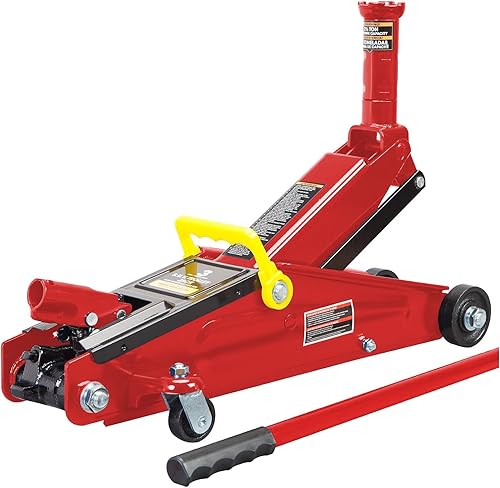 Best for garage lifting
BIG RED T83006 3 Ton Trolley Jack with Extra Saddle

Floor jack vs scissor jack: which should you choose?
Choose a floor jack for repeated lifting in a garage; choose a scissor jack for occasional tire changes and compact storage. The floor jack is easier to reposition around a work area, while a scissor jack kit can keep tire-changing tools together.
The BIG RED T83006 is a 3 ton hydraulic trolley floor jack with a 5-7/8 to 20-7/8 in lift range. Its steel and swivel casters help it move across a garage floor, and its extra long saddle neck is designed to save time when lifting higher vehicles.
The two scissor options are both rated at 3 tons. The IMAYCC jack has a 4.7 to 18.3 in range and comes with a ratchet wrench, lug wrench, gloves, rubber pads and storage bag.
The Gurduenon kit has a 4.3 to 15.74 in range and includes a ratchet wrench, lug wrench, gloves, tire pressure gauge and storage bag.
Our scores weigh specs, features and buyer feedback against what you're shopping for.
How do floor jacks and scissor jacks work?
A floor jack uses hydraulic pressure, while a scissor jack raises through a screw-driven frame. Both raise a vehicle at a contact point, but their size and movement shape how you'll use them.
A trolley floor jack has a long body with wheels and a lifting saddle. You guide it into position, then pump the handle to raise the saddle.
The BIG RED model's minimum height is 5-7/8 in, and its maximum height is 20-7/8 in.
A scissor jack has crossed metal arms that spread as you turn its mechanism. It doesn't roll into position, so you need to place it at the correct lift point before raising.
The kits compared here include ratchet tools for turning the jack.
A jack supports only the load it is designed to lift, when used correctly. Don't assume a capacity rating means the jack will reach your car's lift point or provide enough clearance for your planned repair.
Which jack is easier to position and lift?
A floor jack is easier to roll into place on a clear, level garage floor; a scissor jack is easier to carry and store. The best fit depends on the surface and how much room you have around the vehicle.
The BIG RED's two large steel casters and two 360-degree swivel casters help with maneuverability. Its 36 lb weight and larger frame make it a garage tool rather than the lightest choice for a roadside kit.
A scissor jack's compact shape makes it more practical to keep with tire-changing equipment. The IMAYCC kit includes a storage bag, while the Gurduenon kit includes one along with its tire tools.
A compact jack still needs a firm, level surface and room to operate its handle. Before a trip, learn where your vehicle's jack is stored and how its manual says to position it.
How much lifting height do you need?
Compare the jack's height range with your vehicle's lift point and the clearance required for the job. A higher maximum height can help with some vehicles, but only if the jack can first fit beneath the approved point.
Among these options, the BIG RED has the highest maximum height at 20-7/8 in. The IMAYCC scissor jack reaches 18.3 in, and the Gurduenon reaches 15.74 in.
The minimum heights differ too: 5-7/8 in for the floor jack, 4.7 in for the IMAYCC and 4.3 in for the Gurduenon. A lower minimum height can matter when the approved lift point sits close to the ground.
Measure the lift point and check the manual before buying. A vehicle's ground clearance doesn't necessarily tell you the height at its approved jack location.
If you're comparing a floor jack with a taller support setup, read our guide to choosing the right jack stand height. The jack's reach and the stands' height are separate parts of a safe setup.
Which jack fits common repair tasks?
Use a floor jack for repeat lifting in a garage, and keep a scissor jack for a tire change when its fit is confirmed. Neither jack should be the only support while you work under a raised vehicle.
For tire changes, a scissor jack kit may be convenient because the tools stay together. The IMAYCC set includes a lug wrench with 17/19 mm and 21/23 mm ends, while the Gurduenon kit includes a lug wrench and pencil tire pressure gauge.
For garage work that requires raising a vehicle more than once, the floor jack's wheeled base and hydraulic pump can make repeated positioning and lifting more practical. It still takes more room to store and must be used on an appropriate surface.
For work underneath a vehicle, raise it with a jack, then lower it onto properly rated jack stands at the approved support points. Our guide to floor jacks and jack stands explains how the two tools have different jobs.
Never rely on a jack alone while you are under a vehicle. Follow the vehicle manual and the jack and stand instructions for placement, capacity, and support.
Does a 3 ton rating mean both jacks suit the same vehicle?
No, a shared 3 ton rating doesn't mean two jacks fit the same vehicle or task. Capacity is only one check; height range, lift point, surface and intended use also matter.
The BIG RED has a stated 3 ton (6,000 lb) capacity. The IMAYCC is rated at 3 tons, and the Gurduenon is rated at 3 tons (6,610 lb).
Those figures don't tell you the load carried at an individual lift point or replace your vehicle manual's instructions. Don't choose a jack from the vehicle's total weight alone.
Check the exact vehicle and jack instructions before lifting. If you need help understanding capacity, our guide explains what a 3 ton jack can lift.
What are the trade-offs of a floor jack?
A floor jack trades storage space and weight for a wheeled frame and hydraulic lifting. It suits someone with a garage, a suitable floor and regular lifting needs.
The BIG RED's 36 lb weight is a practical consideration if you'll need to carry it up steps or move it often. Its 5-7/8 in minimum height also means you should confirm that it can fit at your vehicle's lift point.
This model has a safety bypass system to prevent overloading, according to its product description. That feature doesn't replace correct capacity selection, proper positioning or support stands.
If you're still choosing between floor jack styles, compare your vehicle and storage needs in our floor jack guide. For product options, see floor jacks for cars and SUVs.
When is a scissor jack the better choice?
Choose a scissor jack when you want a compact tire-changing tool and have confirmed its range fits your vehicle. Its included tools can be useful in an emergency kit.
The IMAYCC set has the higher maximum lift of these two scissor choices, at 18.3 in. The Gurduenon starts slightly lower at 4.3 in and includes a tire pressure gauge, but reaches 15.74 in at its maximum.
Both require manual operation and a suitable lift point. A jack's included rubber pads or a widened base don't remove the need to follow the manual or work on a stable surface.
Use the vehicle's manual to confirm where to place the jack. If your goal is raising the vehicle for work beneath it, add properly rated jack stands and follow their instructions.
Which should you buy for your setup?
Pick the BIG RED floor jack for repeated garage lifting, the IMAYCC kit for a portable scissor jack with a higher maximum height, or the Gurduenon for a kit with a lower minimum height and tire gauge. Confirm fit against your vehicle manual before choosing any of them.
If you need a jack for occasional wheel changes and limited storage, compare scissor jack fit first. If you work in a garage and lift vehicles regularly, a floor jack is usually the more practical starting point.
For safety, use jack stands before working underneath a raised vehicle.
Are floor jacks safer than scissor jacks?
Neither jack is automatically safe in every setup. Use the jack only at a vehicle-approved lift point, on a suitable surface, and within its capacity and height range.
A jack raises a vehicle, but you should support it with correctly rated jack stands before working beneath it.
Can I keep a scissor jack in my car?
A scissor jack kit can suit an emergency tire-change setup because it is compact and may include tools such as a lug wrench and storage bag. Confirm the jack fits your vehicle's lift point and keep it secured where it won't move around the cabin or trunk.
What should I check before buying a car jack?
Check your owner's manual for the approved lift point, then compare the jack's minimum height, maximum height and capacity with your vehicle and intended task. Consider where you'll use and store it, and whether you need a compact tire kit or a floor jack for garage work.
Can I work under a car raised by a floor jack?
Don't work under a vehicle supported only by a floor jack. After lifting, use properly rated jack stands at the vehicle's approved support points, and follow the instructions for both the vehicle and stands.
A jack's capacity or safety features don't replace those steps.
Frequently asked questions
Is a floor jack better than a scissor jack?
A floor jack is usually the more practical choice for repeated garage work because its wheeled frame can be positioned under a lift point and its handle operates a hydraulic pump. A scissor jack is a compact option for a tire change.
The better choice depends on your work area and vehicle.
Can a scissor jack lift a car for an oil change?
A scissor jack may raise a vehicle, but it isn't a substitute for a safe support setup underneath. Use the vehicle's manual to find approved lifting and support points, and place correctly rated jack stands before working beneath a raised vehicle.
Are floor jacks easier to use than scissor jacks?
A floor jack's hydraulic handle can make raising a vehicle less repetitive than turning a scissor jack's ratchet or screw. A floor jack is heavier and takes more storage space, though, while a scissor jack can fit in a vehicle's emergency kit.
Can I use a scissor jack on an SUV?
Only if the jack's capacity, lift range and contact point suit your SUV. Check your owner's manual for the approved lift point and compare it with the jack's minimum and maximum height.
A stated capacity alone doesn't confirm that a jack fits your vehicle.
Do I need jack stands with a floor jack?
Yes, use properly rated jack stands before working beneath a vehicle raised by a floor jack. A jack lifts the vehicle, while stands support it during work.
Read the vehicle manual for support points and the stand instructions for correct placement.


