How Much Do Floor Jacks Cost?
Floor jacks cost from budget money for a small 1.5 ton jack up to several hundred dollars for a 3 ton low-profile model, and price tracks capacity, lift range, steel build and piston design more than brand name. Most home garages land in the mid-range with a 3 ton jack that fits under a low car.
On this page (7 sections)
- How much do floor jacks cost by size?
- What pushes the price of a floor jack up or down?
- What do you get at each price tier?
- Does a low-profile jack cost more than a standard one?
- What else should you budget for beyond the jack?
- Is a pricier floor jack worth it for home use?
- Quick cost check before you buy
Floor jacks cost from budget money for a small 1.5 ton jack up to several hundred dollars for a 3 ton low-profile model. Price tracks capacity, lift range, steel build and piston design more than brand name.
Most home garages land in the mid-range with a 3 ton jack that fits under a low car.
The size on the box tells you the ceiling weight, not the price by itself. What you pay for is how easily the jack gets under the car, how quickly it lifts, and how well it rolls and steers.
The sections below break the tiers down and point to the upgrades that actually change the price.
How much do floor jacks cost by size?
A 1.5 ton floor jack sits at the budget end, a 2 to 2.5 ton jack in the middle, and a 3 ton jack at the top of the common home sizes. Capacity is the first thing that moves the price up, because more steel and a bigger hydraulic cylinder go into a heavier-rated jack.
The rating is the maximum weight the jack is built to lift. A 1.5 ton model covers small cars and light loads.
A 2 to 2.5 ton jack handles most sedans and crossovers. A 3 ton jack steps up to trucks and SUVs and carries the heaviest steel frame of the three.
For a plain sense of what a 3 ton jack is rated to do, see how much weight can a 3 ton jack lift. The ceiling is 6,600 lb, and that headroom is part of why the 3 ton class costs more than a 2 ton.
Higher capacity usually brings more weight to move around. Our guide to how much a floor jack weighs explains why the heavier jack is harder to carry but more stable under load.
What pushes the price of a floor jack up or down?
Lift range, profile height, piston count and frame steel are the features that separate a budget jack from a mid-range one. Two jacks with the same ton rating can still land far apart in price.
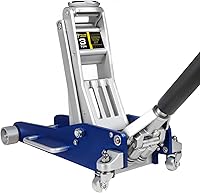
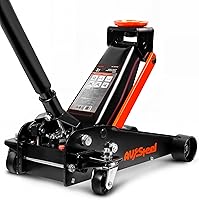
A low-profile jack costs more because it needs a flatter frame and a saddle that starts lower. The AV Steel 3 Ton Low Profile model reaches down to 3-1/8 inches and up to 19-7/8 inches, so it slips under low cars and still lifts high enough for SUVs.
That wide range is a real cost to build.
Dual pistons add cost too. Two pump pistons lift with fewer strokes of the handle than a single-piston jack, which saves time and effort on every job.
A 360° rotatable saddle and overload protection are extra safety parts that budget jacks often skip.
Wheels matter more than people expect. Two rotating rear wheels make the jack easy to steer and roll, and that hardware adds a little to the price.
A cheaper jack with fixed rear wheels is harder to position under the car.
What do you get at each price tier?
Budget jacks do the basic lift, mid-range jacks add a lower profile and faster pumping, and premium jacks add the widest lift range and the smoothest rolling. The tier you need depends on your car's ground clearance and how often you lift.
A budget 1.5 ton jack is fine for an occasional tire swap on a compact car. It lifts to a modest height and takes more handle strokes to get there.
It is the lightest option to carry and store.
A mid-range 2 to 2.5 ton jack adds capacity for a family sedan or crossover. The frame is sturdier, the saddle is a bit larger, and it usually rolls better than the cheapest models.
The 3 ton low-profile tier is the practical top for a home garage. You get the 6,600 lb rating, the 3-1/8 to 19-7/8 inch lift range, dual pistons and ANSI/ASME PASE safety standards in one jack.
Paying above this mostly buys speed and an even lower profile that most driveways never need.
Does a low-profile jack cost more than a standard one?
Yes, a low-profile floor jack usually costs more than a standard-height jack of the same ton rating, because the flatter frame and lower saddle take more careful design. The AV Steel model shows what that money buys: a minimum lift height of 3-1/8 inches, so it fits under low-riding cars and sport utility vehicles that a standard jack can't reach.
If your car sits high, a standard jack is the better buy. You don't need the low saddle, so you don't need to pay for it.
Save the low-profile premium for a car with limited ground clearance or a sports car with a low front lip.
Check your car's clearance before you spend. Measure from the ground to the jacking point, then compare it with the jack's minimum height.
If the saddle won't slide under, the extra money on a low-profile jack is money well spent.
A wider lift range also costs more. A jack that starts low and still reaches 19-7/8 inches covers more vehicles than one with a narrow window, but the longer travel needs a longer piston and a taller frame.
What else should you budget for beyond the jack?
Plan for jack stands, wheel chocks and jack oil on top of the jack price. The jack lifts the car, the stands hold it while you work, and chocks and oil keep the setup steady.
Chocks stop the wheels from rolling, and oil keeps the hydraulic cylinder topped up.
Jack stands are not optional for any work under the car. Never rely on the jack alone to hold a raised vehicle.
Buy stands rated for the load you lift and set them under the factory jacking points.
Wheel chocks are a small cost with a big safety payoff. The MaxxHaul set is solid rubber with a non-slip traction surface, and the built-in handle makes it quick to place and pull out.
A compact 8 x 4 x 6 inch size fits behind tires or in a storage compartment.
Hydraulic oil is the last small item. Check the level now and then and top up if the jack gets slow or spongy.
Bar's Leaks Jack Oil with Stop Leak is a 12.5 oz bottle that works in all floor and bottle jacks and mixes with petroleum, mineral and synthetic fluids. It is non-corrosive, non-clogging and non-foaming.
Our guide to how much hydraulic fluid a floor jack holds helps you judge how much oil to keep on hand.
Is a pricier floor jack worth it for home use?
For most home garages, a mid-range 3 ton low-profile jack is the sweet spot. It covers low cars and SUVs, lifts with fewer strokes, and rolls easily.
Spending more than that buys speed and a lower profile that most home jobs don't need.
The AV Steel 3 Ton Low Profile jack is the clear pick here. It pairs a 6,600 lb rating with a 3-1/8 to 19-7/8 inch lift range, dual piston pumping, a 360° rotatable saddle and overload protection.
AV Steel backs it with a 12-month warranty against design, materials and workmanship defects. That is a lot of jack for the home-garage tier.
Skip the upgrade if you only lift a compact car now and then. A 2 ton jack does that job and costs less.
Step up to 3 ton when you own a truck or SUV, or when you want one jack to cover every vehicle in the driveway.
Look past the sticker when you compare. A cheaper jack that won't fit under your car, or one that needs many strokes to lift, costs you time on every job.
Pay for the lift range and piston count you'll actually use.
When the job is done, how to store a floor jack shows how to keep it upright and out of the way. A well-kept jack holds its value longer than one left lying on its side.
Quick cost check before you buy
Match the price to your car and the work, not to the biggest number on the box. Measure your car's clearance, check the weight you lift, and decide whether dual pistons and a low profile matter for your jobs.
A 1.5 ton jack for a compact car and light use is the budget call. A 2 to 2.5 ton jack for a sedan or crossover is the middle.
A 3 ton low-profile jack for a truck, an SUV or a mixed driveway is the top home tier and the one most people should choose.
Add stands and chocks to the total, and keep a bottle of jack oil in the garage. Those extras are small next to the jack but they are what make lifting safe and keep the jack working.
Set the budget around the lift you need, then buy the jack that fits it.
Frequently asked questions
Why do two 3 ton floor jacks cost different amounts?
The 3 ton rating is only the ceiling. A low-profile jack with a wide 3-1/8 to 19-7/8 inch lift range, dual piston pump and overload protection costs more than a basic 3 ton model with a narrower saddle and a single piston.
What else do I need to budget for besides the jack?
Add jack stands for any work under the car, a pair of wheel chocks to stop rolling, and jack oil for top-ups or a leak. Those extras are small next to the jack but they matter for safe lifting.
Does a floor jack need servicing that adds cost?
Occasionally. Check the oil level, keep the piston clean and store it upright.
A bottle of jack oil with stop leak handles a slow seal leak and costs little compared with replacing the jack.