What Floor Jack Capacity Do You Need?
A floor jack needs a rated capacity of at least 1.5 times the weight it carries at one corner, not the whole car. A 3,000 lb sedan needs a 1.5 ton jack at each lifting point; a 6,000 lb SUV or truck calls for a 3 ton jack.
On this page (8 sections)
- How much capacity does your car's weight call for?
- What is the 1.5x safety margin and why does it matter?
- How do you size a floor jack for an SUV or truck?
- Does the jack's lift range matter as much as its capacity?
- When is a 1.5 ton aluminum jack the better buy?
- Can you use a higher-capacity jack on a small car?
- How do jack stands and ramps fit into the capacity decision?
- Which floor jack would we pick for each vehicle?
A floor jack needs a rated capacity of about 1.5 times the weight it carries at one corner, not the whole car. A 3,000 lb sedan calls for a 1.5 ton jack; a 6,000 lb SUV or standard truck calls for a 3 ton jack.
Capacity is the number printed on the side of the jack. It tells you how much weight the hydraulic cylinder is rated to hold, and it has nothing to do with how high the jack can lift.
Pick it from your vehicle's curb weight first, then match lift range and saddle height to your car's jacking points.
This guide walks through the weight math, the lift-height question and the cases where a lighter jack makes more sense. It ends with the jack we would buy for each type of vehicle.
How much capacity does your car's weight call for?
The first answer is the one most buyers miss: split the curb weight before you pick a rating. A floor jack lifts one corner or one end at a time, so the full vehicle weight never rests on the saddle.
Take the curb weight from the door jamb sticker or the owner's manual. Divide it by the number of lifting points you'll use at once.
For a corner lift that's roughly a quarter of the weight; for a front or rear lift it's closer to half.
Then add the margin. A 1.5x buffer covers uneven weight distribution, the extra force of pumping the handle and any load in the trunk or cargo area.
A 3,000 lb sedan lands near 750 lb at a corner and 1,500 lb at an end, so a 1.5 ton jack covers it comfortably. A 6,000 lb truck needs about 3,000 lb at a corner with margin, which is why the 3 ton class exists.
The split matters because a front-engine car rarely sits at 50/50. On a 3,000 lb sedan, the front axle may carry close to 60 percent of the weight, so a front corner could see roughly 900 lb before you add the margin.
That still leaves a 1.5 ton jack with plenty in reserve.
Lifting the whole front or rear end changes the math. A front lift on the same sedan puts about 1,800 lb on the saddle, and with the 1.5x margin you are near 2,700 lb.
That is close to the top of a 1.5 ton rating, so many owners use a 3 ton jack when they plan to raise an entire end.
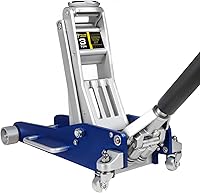
The SATA 1.5 Ton covers 3,000 lb and reaches 14 in. It's aimed at sedans and compact SUVs, which is the band where a lighter jack makes sense.
Its dual-piston pump reduces handle effort and shortens the lift time, and SATA tests each unit to 1.5x its rated load.
Pick a 1.5 ton jack if your car weighs under about 4,000 lb and you lift one corner at a time. Move up when the curb weight or the cargo load pushes the corner weight past about 2,200 lb.
What is the 1.5x safety margin and why does it matter?
The 1.5x margin is the gap between what the jack can hold and what it will actually carry. It covers the things the curb weight number doesn't show.
A front-heavy sedan puts more weight on the front corners than a 50/50 split suggests. A full trunk shifts weight rearward.
Pumping the handle adds a downward force of its own, and an uneven floor changes how the load sits on the saddle.
A 2 ton jack rated at 4,000 lb used on a 4,500 lb SUV leaves 500 lb of margin before any of that. That's too thin.
The same jack on a 3,000 lb sedan has more than 1,000 lb of spare room per corner.
The margin also protects the jack's seals and cylinder. Running a hydraulic jack near its limit shortens its life even when nothing fails on the spot.
The AV Steel 2.5 Ton includes an overload valve that stops the jack from lifting past its rated load, but it's a backstop, not a substitute for choosing the right class.
The margin also covers the load you didn't plan for. A trunk full of tools, a full tank of fuel and a passenger sitting in the car all push the corner weight up past the curb figure.
On a light sedan that rarely changes the class; on an SUV already near 4,500 lb it can tip a 2 ton jack from thin margin to none at all. The overload valve protects the jack, not the person under the car.
Pick a jack rated at 1.5x or more of the corner load, and never less than 1.25x. If your math lands right on the edge of a class, round up to the next size.
How do you size a floor jack for an SUV or truck?
SUVs and trucks need the 3 ton class in most cases. The curb weight and the lift height both push you upward, and the second part is easy to overlook.
A standard mid-size SUV weighs around 4,000 to 4,500 lb. With the 1.5x margin on a corner load, that's roughly 1,500 to 1,700 lb, which a 2 ton jack can technically handle.
But SUVs sit taller, and the jack needs enough maximum lift to reach the frame or pinch weld without stacking blocks under it.
Half-ton pickups run 5,000 to 5,500 lb and sit higher still. Their corner load with margin lands near 2,000 lb, and the lift height requirement rules out most 2 ton jacks.
The AV Steel 3 Ton is rated at 6,000 lb and reaches 18.5 in, which covers standard SUVs and pickups. It starts at 5.5 in, so it slides under most stock-height cars too.
It weighs 63.8 lb, so this is a garage jack rather than something you carry in the trunk. AV Steel notes it isn't meant for lifted vehicles, heavy-duty trucks or RVs.
That exclusion matters more than it looks. A lifted truck's frame sits well above the 18.5 in maximum, so the jack runs out of travel before it reaches a safe lifting point.
An RV or heavy-duty truck pushes past the 6,000 lb rating on a single corner. Neither case is fixed by buying a bigger saddle or a longer handle; they call for a different jack class entirely.
Pick a 3 ton jack for any standard SUV or half-ton pickup. Check the maximum lift height against your jacking points before buying, because capacity alone won't reach a lifted frame.
Does the jack's lift range matter as much as its capacity?
Yes, and for some vehicles it matters more. A jack can have plenty of capacity and still be useless if its minimum height won't slide under your car or its maximum height won't reach the lifting point.
Two numbers matter. The minimum height tells you whether the saddle clears your lowest jacking point, which is the deciding spec for low cars.
The maximum lift height tells you whether the jack can raise the car far enough for the job, whether that's a tire change or a suspension repair.
A low-slung sports car might sit around 4 in at the pinch weld. A jack that starts at 5.5 in won't fit without a low-profile ramp.
The SATA 1.5 Ton starts at 3-1/2 in, which is low enough for most sedans and compact SUVs.
At the other end, a taller SUV or truck needs a jack that reaches its frame. An 18.5 in maximum handles most standard trucks; a short 14 in jack may not.
How to measure your jacking point in both directions
Park on level ground and find the manufacturer's lifting points in the owner's manual. Measure from the floor to the lowest point the saddle will contact.
That figure needs to clear the jack's minimum height with a little room to spare. Then measure how high the car must rise for the job, and compare it to the maximum lift.
A tire change needs less travel than suspension work, so the target depends on what you plan to do.
Measure your jacking point height before you buy, in both directions. A jack that fits under the car but can't reach the frame is no better than one that reaches but won't slide in.
Our floor jack weight guide explains how lift range and weight trade off against each other in the aluminum and steel classes.
When is a 1.5 ton aluminum jack the better buy?
A 1.5 ton aluminum jack wins when you need to carry it or store it in a tight spot. It covers light vehicles and gives up very little for the weight savings.
The SATA 1.5 Ton weighs 29.8 lb and combines an aluminum frame with steel load-bearing parts. That hybrid build keeps it light enough to lift in and out of a trunk or carry up a flight of stairs.
Its dual-piston pump cuts handle effort, and the side handle makes transport easier.
Its 1.5 ton rating covers sedans and compact SUVs up to roughly 4,000 lb with the margin applied. That's the bulk of daily-driver cars.
It isn't the right jack for a full-size SUV or a truck.
The steel 3 ton class weighs two to three times as much. An aluminum floor jack that you can actually carry is worth more than a heavier steel one that stays in the garage because moving it is a chore.
The hybrid design also keeps the footprint small. At roughly 21.65 by 9.45 by 6.1 in, the SATA takes up less shelf space than a long steel jack, and its non-slip rubber handle makes the carry more secure when your hands are greasy.
Those details matter when the jack lives in a trunk or on a closet shelf rather than on a garage floor.
Pick a 1.5 ton aluminum jack if your car is light and you lift away from home. Pick steel if the jack stays in one spot and you need the extra capacity.
A lighter jack also makes storing your floor jack easier, since you can hang it on a wall or tuck it on a shelf instead of reserving floor space.
Can you use a higher-capacity jack on a small car?
You can, but there are trade-offs. A 3 ton jack will lift a sedan safely, yet its size and weight work against it for light-car jobs.
The upside is headroom. A 3 ton jack on a 3,000 lb sedan has a large safety margin and handles anything you might tow or borrow later.
The AV Steel 3 Ton starts at 5.5 in, so it still fits under most stock sedans.
The downsides are real. It weighs 63.8 lb, so getting it out and putting it away takes more effort than a 30 lb aluminum jack.
Its longer frame may not fit in a packed garage bay. And its maximum lift of 18.5 in is more than a sedan needs, which you pay for in weight and footprint.
The 1.5 ton SATA starts lower at 3-1/2 in and reaches 14 in. For a low sedan, the lower starting height matters more than the extra capacity you'd never use.
Pick the smallest jack class that clears your corner load with margin, then check the lift range. Overbuying capacity costs weight and space; underbuying lift height costs you the ability to reach the car at all.
How do jack stands and ramps fit into the capacity decision?
A floor jack lifts; stands hold. The jack's capacity doesn't cover the time the car spends in the air, so the stands carry that load and need their own rating.
The Amazon Basics Steel Jack Auto Stands are rated at 3 tons (6,000 lb) per pair. That's a sensible match for the 3 ton AV Steel jack and for any standard SUV or truck.
The self-locking ratchet means no locking key, and the stands adjust from a low setting up to 16.34 in. The steel frame has a rustproof coating.
For a 1.5 ton car, a 3 ton stand pair gives a wide margin. The pair rating is what matters: two stands share the load, so a 6,000 lb pair holds 3,000 lb per stand.
A 3,000 lb sedan split across two stands leaves each one with plenty in reserve.
Match your stand rating to the jack rating or above, and always use stands once the car is up. A floor jack is a lifting tool, not a support.
Never work under a car held only by the hydraulic cylinder.
Ramps are a third option for jobs that don't need the wheels off. For oil changes and inspections, drive-up ramps keep the car on its wheels and skip the jack-and-stand routine entirely.
The capacity question shifts to the ramp's rating, which should also carry a margin over the vehicle's axle weight. Note that the stands adjust to 16.34 in, so set them close to the height you need before you slide them under; raising a car high and then lowering it onto short stands wastes the lift and risks a sloppy landing.
Which floor jack would we pick for each vehicle?
The choice comes down to vehicle weight first, lift height second, portability third. Here's how the three jacks we looked at line up for common vehicles.
For a sedan or compact SUV, the SATA 1.5 Ton is the pick. Its 1.5 ton rating covers the corner load with margin, its 3-1/2 in starting height slides under low cars, and its 29.8 lb hybrid build is easy to carry and store.
The dual-piston pump is a nice bonus when you lift often.
For a standard SUV or half-ton pickup, the AV Steel 3 Ton is the pick. Its 6,000 lb rating covers the corner load with room to spare, and its 18.5 in maximum lift reaches most stock truck frames.
The 63.8 lb weight is the trade-off you accept for that capacity.
For holding the car once it's up, the Amazon Basics Steel Jack Auto Stands match the 3 ton class and adjust up to 16.34 in. Pair them with either jack and never rely on the jack alone.
Pick 1.5 ton if your car is light and you lift away from home; pick 3 ton if it's an SUV, truck or anything near 4,000 lb. Check the lift range against your jacking points before you buy, and remember that the stands carry the car while you work.
Our floor jack buying guide covers the rest of the specs to compare once the capacity question is settled. And if the jack will live in the garage rather than the trunk, read up on how to store a floor jack so it stays out of the way between jobs.
Frequently asked questions
Is a 3 ton floor jack enough for an SUV?
For most standard SUVs, yes. A 3 ton jack is rated for 6,000 lb and lifts one corner or end at a time, so it covers vehicles up to roughly 4,000 lb with the usual 1.5x safety margin.
Check your SUV's curb weight first, and skip lifted or heavy-duty models.
Can I use a 2 ton floor jack on a full-size truck?
No. A full-size half-ton pickup often weighs 5,000 to 5,500 lb, so a single corner can approach 2,500 lb.
A 2 ton jack rated at 4,000 lb leaves little headroom once the safety margin is applied.
Move up to a 3 ton jack for standard trucks.
Does a higher capacity jack lift higher?
Not always. Capacity and lift range are separate specs.
The AV Steel 2.5 Ton reaches 14.6 in while some 2 ton jacks top out lower.
Match the maximum lift height to the height of your jacking points, and the minimum height to how low your car sits.
What is the safety margin for a floor jack?
A common rule is to pick a jack rated at 1.5 times the load it will carry. The load is one corner or one end of the car, not the full curb weight.
The margin covers uneven weight distribution and the extra force you apply while pumping.
Do I need a different floor jack for an electric car?
EVs are heavier than comparable gas cars, so check the curb weight and add the 1.5x margin. AV Steel also recommends a jack point adapter on EVs so the saddle lines up with the manufacturer's lifting points.
A 3 ton jack usually covers standard EVs.
What is the difference between a 1.5 ton and a 3 ton floor jack?
The 1.5 ton rating covers 3,000 lb and suits sedans and compact SUVs. A 3 ton jack covers 6,000 lb and takes on heavier vehicles.
The 3 ton steel models also weigh much more, so a 1.5 ton aluminum jack is easier to carry and store.