Low Profile vs Regular Floor Jack: Which Fits Your Car? (November 2026)
Pick a low profile floor jack for a car with less than about 5 inches of ground clearance and a regular jack for a taller truck or SUV. In this low profile vs regular floor jack comparison, the deciding number is how much room sits under your jacking point.
On this page (6 sections)
Pick a low profile floor jack for a car with less than about 5 inches of ground clearance and a regular jack for a taller truck or SUV. The low profile vs regular floor jack question comes down to one measurement: how much room sits under the jacking point on your vehicle.
A low profile jack starts lower so it slides under a lowered car. A regular jack starts higher and often reaches further up, which helps with lifted trucks and vans.
The wrong pick leaves you either unable to fit the saddle under the car or unable to raise it far enough.
This comparison covers four jacks across both styles and the points that decide the choice: starting height, top height, capacity and weight.

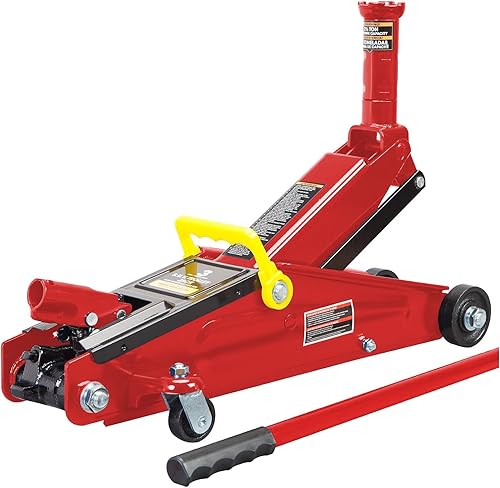 Best for trucks and SUVs
BIG RED T83006 3 Ton Trolley Jack with Extra Saddle
Low profile vs regular floor jack: which fits under your car?
A low profile floor jack fits when your jacking point sits lower than the jack's starting saddle height. Measure the gap under the car at the lift point, not the gap at the bumper, because the saddle has to reach the frame or subframe.
The DNA MOTORING starts at 5.1 inches, and the BIG RED starts at 5-7/8 inches. The DNA MOTORING is built as a low profile jack, while the BIG RED is a regular-height start.
The Jack Boss starts at 3-15/16 inches, so it clears most lowered cars and aftermarket body kits. The Maxority is built as a low profile jack for low-clearance vehicles.
If your car sits at stock height, a 5 inch start usually works. If it's been lowered or has a deep front lip, the saddle won't clear, and that's when a low profile jack earns its place.
How to measure your clearance
Park on level ground and find the maker's lift point in your owner's manual. Slide a tape or a block of wood under it and read the height.
Compare that number to the jack's minimum height and leave a little margin for the saddle and any load sag.
Write the number down. It's the single spec that decides low profile vs regular floor jack for your car.
Why a regular jack starts higher
A regular jack like the BIG RED carries more steel and a taller body to reach its 20-7/8 inch top. That extra structure is what pushes the starting saddle up to 5-7/8 inches.
You trade a little ground clearance for a lot of top height and a 3 ton rating.
That's why the low profile vs regular floor jack choice splits by vehicle. Lowered cars need the low start and give up some top height.
Trucks need the top height and can spare the ground clearance.
How high does each jack reach?
Top height matters as much as the starting height, because a car that starts low may still need a tall lift. A low start doesn't guarantee enough reach for a truck, and a tall reach doesn't help if the saddle won't slide under.
The DNA MOTORING tops out at 13 inches, which is fine for sedans and crossovers but short for a lifted truck. The BIG RED reaches 20-7/8 inches and is built for vans and extended height trucks.
The Jack Boss covers 18-5/16 inches, and the Maxority goes to 19.9 inches.
The Jack Boss and Maxority are the flexible middle ground: low enough to start under a sports car and tall enough to serve many stock SUVs. For a home garage with one or two cars, that range covers more jobs.
A 13 inch top height runs out of travel on anything much taller than a crossover.
Height also affects how much pumping you do. The BIG RED uses a single piston quick lift pump, and the Jack Boss and Maxority use dual piston pumps.
Both designs cut the pump count compared with a basic jack.
Matching top height to the job
For a tire swap on a sedan, 13 inches is usually enough to get the wheel clear of the ground. For a lifted truck or a van, you need the 20 inch class.
For a stock SUV, 18 to 20 inches gives comfortable working room under the wheel arch.
Measure how high the wheel has to come up before the tire clears, then add a couple of inches of margin. If the jack's top height is close to that number, step up to the taller jack.
Which jack has the right capacity for your car?
Match the jack's rating to the corner weight, not the whole car. A typical sedan carries around 1,000 to 1,200 lb at one corner, so a 2 ton (4,000 lb) jack leaves plenty of headroom.
The DNA MOTORING is rated 2 tons (4,000 lb), and DNA MOTORING notes it isn't meant for pickups or large SUVs. The BIG RED, Jack Boss and Maxority are all rated 3 tons (6,000 to 6,600 lb), which gives more room for heavier vehicles and for lifting one end rather than one corner.
Capacity also affects how the jack feels in use. A 3 ton steel jack weighs more and takes more effort to roll and position.
For a light car in a small garage, the 2 ton DNA MOTORING is easier to handle.
Safety features built into the rating
Each jack here includes an overload safety valve or bypass system. On the DNA MOTORING a safety release valve triggers in the event of an overload.
The BIG RED uses a safety bypass system to prevent over-loading, and the Maxority puts a built-in safety valve in the lift saddle. The Jack Boss goes further and is factory tested to 4.5 tons (9,900 lb), 1.5X its rated 3 ton capacity, and meets ANSI/ASME PASE safety standards.
Those features protect the jack, not you. None of them replaces a jack stand once the car is up.
How much does weight and size matter in the garage?
The lightest jack here weighs 9.75 kg (about 21.5 lb), and the heaviest weighs 58.5 lb. Weight decides how easy it is to pull the jack out, roll it into place and lift it onto a shelf.
The DNA MOTORING is the lightest and easiest to move around a home garage. The BIG RED at 36 lb and the Jack Boss at 58.5 lb are heavier shop tools that suit a dedicated bay more than a shared parking space.
Size matters too. The DNA MOTORING measures 10 x 19 x 8 inches, so it stows on a shelf or in a corner.
The Jack Boss measures 28.3 x 13.7 x 7.8 inches, long enough that it needs a clear stretch of floor in front of the car. The bigger jacks need more floor room and a wider path to roll into position.
Wheels and handle details
The casters decide how well the jack rolls and steers under the car. The DNA MOTORING uses swivel casters, and the BIG RED pairs two large steel casters with two 360-degree swivel casters.
The Jack Boss uses steel casters and swivel front casters. Better casters mean you can steer the saddle to the lift point without dragging the jack sideways.
The handle matters too. The BIG RED's handle is 24.5 inches long, and the Jack Boss ships with a two-piece handle.
A longer handle gives more leverage per pump. The Jack Boss also includes a rubber saddle to protect lifting points, while the BIG RED's extra long saddle neck reaches higher vehicles without extra pumping.
Low profile vs regular floor jack: who should buy which?
Buy the DNA MOTORING for a normal car and a home garage; buy the BIG RED for a truck or SUV; buy the Jack Boss or Maxority for a lowered car that still needs a tall lift. Each jack wins a clear case.
The DNA MOTORING 2 Ton Low Profile Hydraulic is the best overall pick for most readers, and it carries the highest score here. Its 2 ton rating, 5.1 inch start and light 9.75 kg build make it a simple jack to live with for a sedan or crossover.
If your car has normal clearance and you don't work on trucks, this is the one to get. The large saddle adds stability, and the overload valve covers the safety basics.
The BIG RED T83006 wins for trucks and SUVs. Its 3 ton rating and 20-7/8 inch top height reach lifted vehicles, and the extra long saddle neck saves pumping time when you need height fast.
It's the regular jack to choose when the vehicle is tall. The 5-7/8 inch start rules it out for very low cars, so it belongs in a garage built around a truck or van.
The Jack Boss 3 Ton Aluminum and Steel Racing Floor Jack wins for lowered sports cars. A 3-15/16 inch start gets under a slammed car, and 18-5/16 inches still reaches a stock SUV.
It's the best all-rounder for a garage with a mix of low and normal cars. The rubber saddle protects lifting points, and the dual piston pump reduces the pump count.
The Maxority 3 Ton Low Profile Steel Floor Jack wins when reach matters more than anything else. Its long reach gets to central jacking points on lowered and modified cars, and 19.9 inches gives good height.
The 90 day warranty is the short side, so weigh that against the reach. The random color is a minor quirk, but if the finish matters to you, order with that in mind.
Quick setup and safety notes
Every jack here is a lifting tool only. Lower the car onto rated jack stands before you go underneath, and never use the jack as a stand.
Check the owner's manual for the correct lift points on your car. The DNA MOTORING's own instructions make the same point: it's for vertical lifting only and can't be used where side or downward force is required.
If you're lifting a low car on a slope or a gravel drive, fix the surface first. A jack that rolls on an uneven floor is a real risk.
For ramps as an alternative on low cars, our guide to low profile car ramps covers the option that avoids jacking altogether.
Ramps or a jack for low cars?
Ramps suit oil changes and jobs where the wheels stay on the ground. A jack is better when you need to remove a wheel.
Our comparison of car ramps vs floor jack helps you choose for home oil changes. If you're also weighing a jack against the tool in your trunk, see floor jack vs scissor jack.
For a closer look at the Jack Boss, our Jack Boss floor jack review goes deeper on its dual piston pump and build.
Which floor jack should you buy?
Buy the DNA MOTORING 2 Ton Low Profile Hydraulic for most home garages, because its 2 ton rating and 5.1 inch start cover ordinary cars without the weight of a shop jack. That's the low profile vs regular floor jack call for a typical sedan or crossover.
Go with the BIG RED T83006 when your main vehicle is a truck or SUV and you need the 20-7/8 inch reach. Choose the Jack Boss when you own a lowered car and still want height for a second vehicle.
Pick the Maxority when long reach under a modified car is the priority and the short warranty doesn't bother you.
Measure your lift point before you order. That number, more than the badge or the brand, tells you which style fits your car.
Check the top height against your wheel-clearance target next, then confirm the rating against the corner weight. When all three line up, the low profile vs regular floor jack question answers itself.
Frequently asked questions
Is a low profile floor jack worth it for a normal car?
A low profile jack is worth it when your car's jacking point sits below about 5 inches, which covers many sedans and sports cars. If your car has plenty of clearance and you also work on taller vehicles, a regular jack's extra top height often serves you better.
What is the difference between a low profile and a regular floor jack?
The main difference is the starting height. A low profile jack slides under cars with little ground clearance, while a regular jack starts higher and usually reaches further up, which helps with trucks and SUVs.
Capacity and weight also change between the two.
Can a low profile jack lift an SUV?
It can when its top height is tall enough. The Jack Boss reaches 18-5/16 inches and the Maxority reaches 19.9 inches, both of which cover many stock SUVs.
Check your SUV's lift point height against the jack's maximum before you buy.
Do I still need jack stands with a floor jack?
Yes. A floor jack is a lifting tool only and must not hold a load for any long period.
Once the car is up, lower it onto rated jack stands placed at the maker's lift points before you go underneath.
How much capacity do I need in a floor jack?
Match the jack's rating to the weight it carries at one corner, not the whole car. A 2 ton jack suits most sedans and crossovers, while a 3 ton jack gives more headroom for heavier trucks, SUVs and vans.


